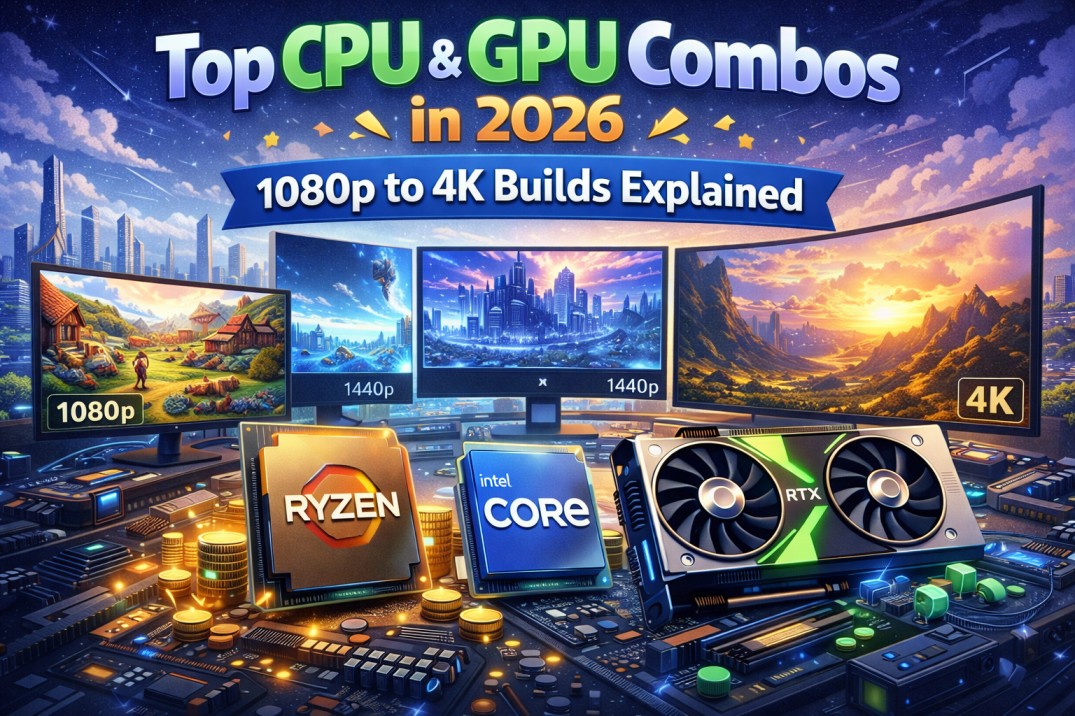
Top CPU & GPU Combos in 2026: 1080p to 4K Builds Explained


Building a Gaming PC in 2026

Building a gaming PC in 2026 is no longer about seeking the best hardware but rather achieving the optimal balance. An unbalanced build may be silently limiting your potential, even though you have spent a lot on the hardware you have chosen.

An optimal CPU and GPU pairing is essential in delivering a smoother gaming experience and a longer lifespan.

This article discusses the optimal CPU and GPU pairing depending on the resolution and considers some practical factors like VRAM and upscaling support.

Why CPU and GPU Balance Still Matters

At a basic level, the workload in gaming shifts depending on resolution. At 1080p, the CPU has to work harder because frames are rendered quickly. At 4K resolution, the GPU becomes the bottleneck element due to the sheer number of pixels.

However, this is not set in stone. There are games out there that are CPU-intensive even at higher resolutions.

That’s why the importance of a balanced combo is higher than making assumptions.

Best 1080p Combo for High FPS Gaming

In competitive gaming at 1080p resolution, your CPU plays a major role in maintaining high FPS. Games such as Valorant, CS2, and Fortnite are suited for good single-core performance, which both of these processors have.

Recommended Combo:

  • CPU: AMD Ryzen 5 7600 / Intel Core i5-13400F
  • GPU: NVIDIA RTX 4060 / AMD Radeon RX 7600

When it comes to the GPU selection, both of these can handle esports titles at over 144 FPS. However, there is a difference to be considered. The NVIDIA RTX 4060 has support for DLSS 3 and frame generation, which can boost performance in supported games. The RX 7600, on the other hand, leans more toward raw raster performance.

One important limitation here is VRAM. Both of these GPUs have 8GB, which is becoming the new norm, causing a limitation in the latest AAA titles, even at 1080p with ultra textures. It’s best used if you’re more into competitive gaming rather than heavy cinematics.

Best 1440p Combo – The Sweet Spot for Most Gamers

1440p is still the sweet spot for most gamers when it comes to resolution. In this segment, the GPU plays a more critical role, but the CPU must also keep up with the pace.

Recommended Combo:

  • CPU: AMD Ryzen 5 7600, Intel Core i5-14600K
  • GPU: NVIDIA GeForce RTX 4070 Super, AMD Radeon RX 7800 XT

The NVIDIA GeForce RTX 4070 Super excels at ray tracing, offering DLSS 3 as well, making it a solid choice for visually rich games. Meanwhile, the RX 7800 XT offers 16GB of VRAM, which gives it an advantage in memory-heavy titles and improves long-term usability.

Best 4K Combo for High-End Gaming

In 4K gaming, the GPU takes the spotlight as the driving force behind the system. However, it’s also worth noting that the GPU must be paired with a good CPU, as the frames per second must be smooth, especially when it comes to scenes with heavy processing.

Recommended Combo:

  • CPU: AMD Ryzen 7 7800X3D / Intel Core i7-14700K
  • GPU: NVIDIA RTX 4080 Super / AMD Radeon RX 7900 XTX

The Ryzen 7 7800X3D is still one of the best CPUs for gaming, as it comes equipped with 3D V-Cache. It is great for running many of the current gaming titles. The i7-14700K is a very powerful CPU, especially for those who plan on doing productivity along with gaming.

As for the GPU, the RTX 4080 Super is great for ray tracing and comes with support for DLSS 3, making it ideal for advanced gaming needs. The RX 7900 XTX, meanwhile, prioritizes performance and includes a large VRAM buffer, which is necessary in recent gaming titles.
Gaming at 2 AM Hits Different – Here’s the Actual Reason Why

You know the feeling. It’s past midnight. The house is quiet. Your phone stopped buzzing an hour ago. You put on your headset, launch your game, and suddenly something clicks. The match feels different. The calls with your squad feel sharper. The jokes land harder. And somehow, the random teammate who would have annoyed you during the day becomes someone you actually vibe with.

This isn’t just in your head. There’s a reason 2 AM gaming sessions work so well, and it’s not just about having fewer distractions. It’s about something deeper: the way social pressure shifts, the kind of connections that form, and the mutual understanding that only happens when the rest of the world goes quiet.

Your Brain Literally Changes at Night

Let’s start with the obvious thing nobody actually explains: why does 2 AM feel so different from 2 PM for social gaming?

The short answer is cortisol. Your body’s primary stress hormone peaks in the early morning (around 8–9 AM for most people) and gradually drops throughout the day. By late night, it’s at its lowest. A 2019 study published in Psychoneuroendocrinology found that lower cortisol levels correlate directly with reduced social inhibition, meaning you’re physiologically less guarded, less performative, and less concerned with how you come across.

This means you stop overthinking. You stop calculating every move like it’s a spreadsheet. You start feeling the game instead. During the day, your brain is in “performance mode.” You’re thinking about work, about responsibilities, about that thing you forgot to do. At night, that noise fades. Your reactions become more instinctive. Your focus deepens. And here’s the kicker: your brain encodes nighttime experiences more deeply than daytime ones. Those 2 AM boss fights stick with you precisely because they happen at 2 AM.

The Social Pressure Valve Releases

Here’s the thing about daytime gaming: there’s always someone watching. Not literally, but socially. You’re aware that you “should” be doing something else. Work, chores, being productive. That awareness creates a low-level hum of social pressure that affects how you play and who you play with.

At 2 AM, that pressure disappears. You’ve finished your day. You’ve done your work. The time now belongs to you, and no one can argue that you should be doing something else. This isn’t just about guilt; it’s about permission. When you give yourself permission to fully be in the game, you show up differently. You’re more open. More patient. More willing to try things that might fail. And that openness extends to the people you play with.

Self-Disclosure at Midnight: Why People Actually Open Up

Self-disclosure, the act of sharing personal thoughts and feelings, usually follows a slow, predictable path in most social settings. You start with safe topics and only go deeper after trust builds over time. But late‑night gaming shatters that pattern. Part of it is the “online disinhibition effect,” when people feel semi‑anonymous, even with friends, they share more freely. Voice chat in a game hits a strange sweet spot where you’re present enough to feel connected, but you’re staring at a screen, not making eye contact, so the vulnerability threshold drops. 

Then there’s what social psychologists call “incidental intimacy.” When you and your teammates pull off a comeback win in Rocket League, recover from a near‑wipe in a Destiny 2 raid, or clutch a 1v4 in CS2, the emotional intensity of that shared, high‑stakes moment fast‑tracks closeness. At 2 AM, with nowhere else to be, the warmth from those moments has nowhere to go except into conversation.

Mutual Understanding: The Language That Only Works Inside the Game

One of the most underappreciated dynamics in late-night competitive gaming is the depth of mutual understanding that develops between regular teammates.

This is called common ground, the accumulated set of shared knowledge, experiences, and references that makes communication efficient and intimate. In a long-running squad in Warzone or Overwatch 2, communication gets compressed into shorthand that would be meaningless to an outsider. A specific callout, an in-joke about a map, a reference to a legendary game from six months ago, these aren’t just efficient. They’re markers of belonging.

This kind of mutual understanding and social connection takes time to build, and it builds fastest under pressure. Competitive multiplayer games are extraordinarily efficient at generating shared pressure. Every ranked match in Valorant or Street Fighter 6 is a little forge. Win together, lose together, adapt together. 

The night part matters here, too. Daytime gaming often happens in shorter windows, with more interruptions. Late-night sessions tend to run long. They go the distance. And the longer a session runs, the more the shared experience compounds, and the more the mutual understanding deepens.

Concluding Thoughts

The 2 AM gaming session looks, from the outside, like avoidance, someone hiding from real life in a virtual one. But look closer, and you’ll find social pressure operating as motivation, self-disclosure flowing because the barriers are down, mutual understanding built through hundreds of shared moments, and social connection doing exactly what it’s supposed to do: making people feel less alone.

Disclaimer: The content on this blog is for informational and educational purposes only. While we aim to provide accurate information, we can’t guarantee its completeness or accuracy. The views expressed are those of the authors and may not reflect those of the blog.